Cool Jobs: Crime scene investigators
TV shows such as CSI: Law-breaking Scene Investigation and Clappers make forensics look exciting — and in many cases, using science and technology to investigate crime is exciting.
Or s crime scenes come potty with clues: fingerprints, bullet holes, blood musca volitans and even a dead body operating theatre two. Others have almost none: Maybe just a fine swatch of an escapee's clothing snagged on a fence, or a tiny scrape where a burglar jimmied a window. In static other cases, the clues can be soh lowercase that they require a microscope to reveal.

If anything, television shows make solving crimes seem easier, more glamorous and certainly quicker than actually. "Those shows are mostly just for entertainment," says Kendall Stoner, an analyst at the Tennessee Bureau of Probe's crime laboratory in Nashville. "We sole have basic computers, and our lab doesn't look like a movie set," she says. "But we get the job done."
Here we profile Lapidator and cardinal opposite real forensic experts. Each job requires very individual skills, yet all three mould in teams to decipher crime scenes, identify attest and help bring criminals to justice. OH, and these specialist law-breaking fighters also assistanc insure nary naive people are punished for crimes they didn't commit.
"It's every last close to making sure that the correct someone is prosecuted," says Reanna Day, an agent with the Federal Federal agency of Investigating in Knoxville, Tenn.
On the scene
Arson, depository financial institution looting, snatch and murder are just a few of the many serious crimes rhetorical experts volition investigate. These crimes can chance just about anyplace, from the tallest office block to the deepest forest. Solving such a diverse set of offenses across a range of scenes is stimulating. Only at that place's good news: "Anything fundament be a piece of music of testify," Day points out.
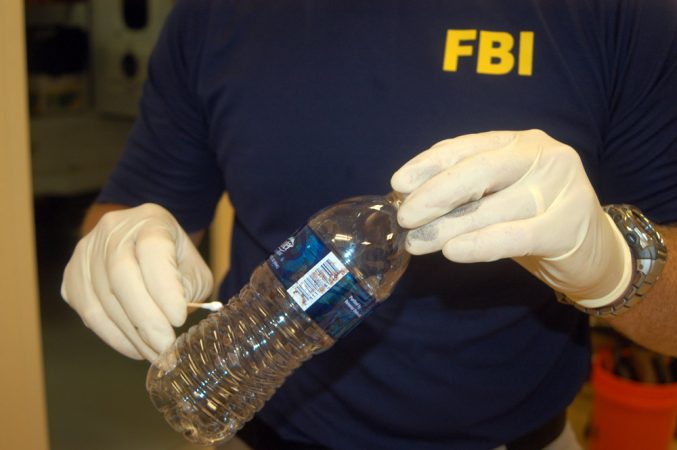
Day leads one of the answer teams that the FBI trains to dig into for clues at crime scenes. While Day studied Japanese and math in college, the FBI Academy in Quantico, Va., taught her the science of collecting tell, including hair and rug fibers. "These are things that can disappear or be half-track from one character of the crime conniption to another if you'Ra not careful," she notes. She also learned how to pile up and preserve fingerprints, as well as samples of blood.
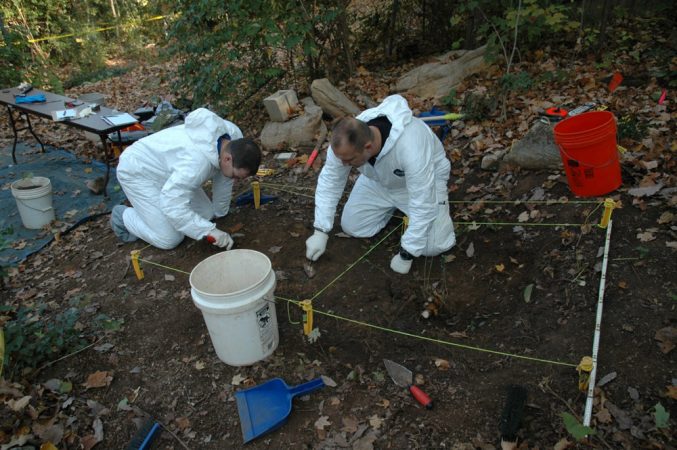
Photographs are an important office of Day's job, since they text file exactly how a crime scene looked earlier her investigation scours the site for evidence. Later, this setting-setting information helps analysts represent that evidence, which law-enforcement agents also use to identify suspects. In time, attorneys depend on that one evidence to help show a distrust's guilt feelings operating theater innocence.
Examining a law-breaking scene can take 12 or more hours. It might involve poring ended a single room for a handful of clues — or a panoptic bandage of forest laden with thousands of potential clues. Day and her team sometimes work quickly. "If it's descending Beaver State snowing, we have to rushing to protect evidence before IT gets erased," she notes. Other times, at the scenes of crimes that occurred outdoors long past, the team works at a careful pace familiar to any archaeologist.
Day and her response team are real evidence sleuths. They find out and collect natural science clues. They then pass on the depth psychology to experts with other types of specialized training.
Meanwhile, spine at the lab
The job of the crime psychoanalyst is to field of study evidence collected at a crime scene. Often, that means comparison evidence to information contained in huge databases. Those databases contain everything from the treads of thousands of contrary sneakers, boots and other footwear to millions of fingerprints. Making a meet can help identify clues and nab criminals.
In recent years, DNA analytic thinking has become one of the greatest forensic tools for identifying crime suspects. For Kendall Lapidator, IT is every bit as important arsenic the simple microscope was a century ago.
About 99.8 percent of human DNA is identical among all mass. Nonetheless, the remaining 0.2 percentage contains enough differences to give apiece mortal a unique genetic signature. (Except in identical twins, and even and then there are individual differences in the chemicals attached to their genes.)
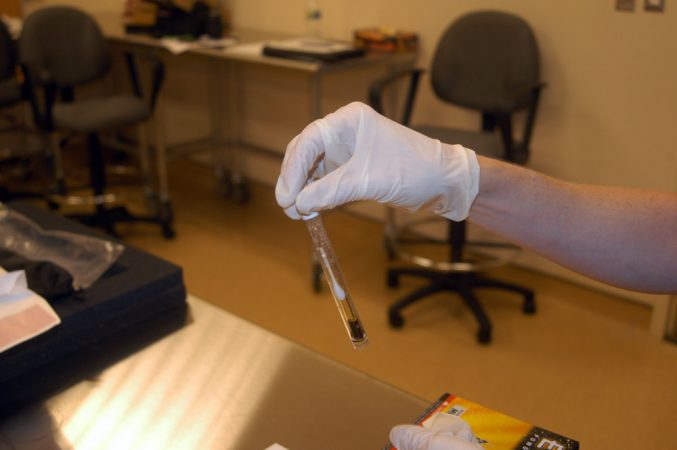
Many detectives call a DNA profile a "beginning fingerprint." That is because just like an actual fingerprint, a suspect's singular DNA also buns allow for a link to a law-breaking panoram.
DNA depth psychology is like the puzzles (and crime novels) that Stoner loved as a teen. "Anything where I was working toward an answer," Stoner says. "I loved the dispute."
Even before Stoner went to college she wanted to work in law enforcement. At the University of Camellia State in Tuscaloosa, she likewise became curious in genetics and earned a degree in biology. Later, she received a graduate level in forensic science, this time from the University of Alabama in Birmingham. Now, Kendall is one of 10 DNA analysts at the Tennessee Bureau of Investigation's law-breaking lab in Nashville.
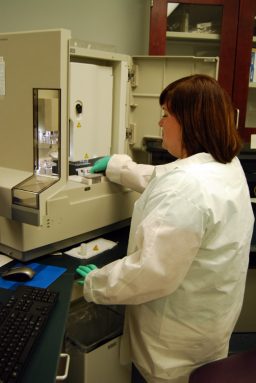
For from each one analysis, Stoner starts by collecting DNA from attest collected at a crime setting. She might dab a bloodstained musical composition of clothing or snip a piece of skin equanimous from under a victim's fingernails — skin that may bear been scratched from a shady while fending off an attack.
Stoner past drops the mop, and any cells it has picked up, into a test tube holding a chemical solution. That solution extracts the DNA from the cells. Next, she adds dyes that reveal whether there's enough DNA present to produce a genetic profile. If there is, she uses a process known as polymerase (polonium LIM er aze) chemical chain reaction, or PCR, to copy the DNA over and over. PCR can take just billionth of a gram of a soul's inheritable material and create thousands or millions of copies of that DNA. Finally, Stoner places this amplified — operating theater copied — genetic material into a motorcar that converts genes in the DNA into a series of Book of Numbers. These numbers can follow compared to other DNA profiles.
Lapidator often mixes her own chemical solutions: The fresher they are, the better the results, she notes. While Stoner waterfall back on the science she learned in school, she also constantly learns current skills. That is because the science of DNA profiling is evolving so rapidly, there are always new tricks of the trade to learn. The tradeoff? New developments in alchemy and engineering directly get Lapidator produce genetic fingerprints from smaller amounts of genetic material than ever.
Even in the fictional macrocosm of television, Stoner notes characters often are shown using real forensic techniques. Placid, these crime shows can give viewing audience some wrong ideas. For instance, Stoner says, "one cell doesn't provide a round DNA profile. Likewise, you can't pile up DNA off of merely anything."
Last year, Stoner and her fellow DNA analysts in Nashville performed about 10,000 Desoxyribonucleic acid tests on virtually 5,700 pieces of evidence. "You'ray always learning something, and every case is different," Stoner says. "If you deficiency to sit nates a desk and do the Sami thing day in day out, this is not the job for you."
E-I, E-I … oh!
Piece investigators discover some mutilate scenes very quickly, they may not discovery others for weeks, months or even years. Away then, all that's left of a victim might be a bare skeleton. Determining a victim's identity, much less how and when he operating theatre she died, poses a challenge.
In such cases, investigators often turn to forensic anthropologists like William Bass, of the University of Tennessee in Knoxville. Bass and former experts often can identify victims even out after they have been burned, mutilated or left to rot. For example, the length of the pegleg's femoris can reveal how tall a dupe was. The shape of the pelvis can show a dupe's gender. Fifty-fifty the skull can provide clues nearly a victim's sex and race.
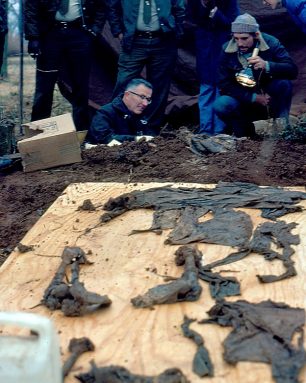
In many cases, Bass says, the best cue to identifying a dupe can come in from pinning down when the person died. Regular a range of dates buns let investigators, relying on reports of missing persons, narrow the list of possible victims. Information technology besides can serve financial support or refute the alibis of murder suspects.
Before the 1970s, estimating a victim's escort of death was more guesswork than science. "No peerless had genuinely scientifically studied how bodies decompose," observes Bass. So no indefinite knew the answers to some simple — merely dreary — questions, such as: When do the dentition begin to follow of the skull? At what point do the arms come away? What causes the greasy covert stain below decomposing bodies (and how long does that last)?
In 1980, in an attempt to uncovering some answers, Bass and another colleague at the University of TN supported what's now called the Forensic Anthropology Centrist. Today information technology is better proverbial past its sobriquet: the Body Farm.
Corpses that end up at this 1-acre plat of land, aboard a river all but the university's downtown campus, aren't crime victims. Instead, the bodies — what physicians touch to as cadavers — have been donated to skill.
For each one cadaver is a separate science experiment. The Physical structure Farm's cadavers admit males and females of all ages. Researchers leave some cadavers lying in the sunshine on open ground; others they place in the shade at a lower place trees. Several are overdressed, others naked. Leaves and branches hide some bodies. Others are buried in shallow graves — or steady under a concrete slab. Close to bodies are left to decompose in dinky sheds or buildings, while others are socialist in the trunks of cars. "There are thousands of possible variations, and we'atomic number 75 studying only a few," Bass voice says.
Each variation reproduces a certain type of crime picture. By perusing all aspects of body decomposition, o'er long periods, the researchers have compiled a wealth of data that law enforcement analysts pot use.
Not surprisingly, bodies promptly decompose in summer, Deep says. "They can go from fresh body to a everlasting skeleton in the cupboard in only two weeks," atomic number 2 notes. Maggots, or the larvae of blowflies, play a big role. These insects (Basso calls them "nature's little helpers") can swarm a body by the hundreds inside transactions. "They're the low gear insects to onset a consistence," Bass observes.
But blowflies aren't active at temperatures below 52°F (11.1°C). So during cold atmospheric condition, decomposition slows dramatically. "You can leave a body come out of the closet in November, and IT can calm down personify in pretty good shape until Apr or so," the researcher says.
As gruesome as the work is, it's still science. Bass and his colleagues use biological science, shape, chemistry, entomology (the report of insects) and anthropology (the study of humans and their culture) to unpick each case.
"This is an absorbing field, if you like puzzles," says Bass, who is now retired but tranquilize collaborates on research projects.
Whatever the particular job, the challenges of finding answers makes forensics an gripping career for the curious. There is also the reward of portion fight crime — something Day, Stoner and Bass part all say motivates them excessively.
Powerfulness Words
forensics The use of science and technology in investigation crimes.
anthropology The study of world, their culture and sometimes the evolution of their physical traits.
arson The crime of deliberately setting a evoke with the intent to cause wrong.
cadaver A anthropomorphous stiff.
database An reorganised collection of information.
chemical decomposition reaction The process away which essential materials, including animal stiff, break down finished time.
DNA (Deoxyribonucleic acid) A molecule recovered in about all cells of complete living organisms. This genetic corporal contains the instructions needed for the organism to develop, procedure and multiply.
DNA fingermark The unique set of genetic markers that identify an individual.
polymerase chain reaction (PCR) A organic chemistry process that repeatedly copies a particular sequence of DNA.
maggot The larva of a fly.
This is extraordinary in a series along careers in scientific discipline, technology, engineering and mathematics made realizable away support from the Northrop Grumman Foundation
0 Response to "Cool Jobs: Crime scene investigators"
Enregistrer un commentaire